¶ Valadao Voted To Cut Californians’ Medicaid After Repeatedly Assuring Them That Protecting It Was A Top Priority
¶ February 2025: Valadao Expressed Concerns That The Proposed Budget Resolution Would Go Against Promises Made by Trump Not To Cut Medicaid And Then Voted For It ANYWAY
¶ 2/14/25: Valadao Expressed Concerns That The Proposed Budget Resolution Would Go Against Promises Made By Trump Not To Cut Medicaid
2/14/25: Valadao Claimed That The Budget Framework Would Go Against Trump’s Commitment Not To Cut Health Care, Saying He Was “Very Much Watching” Medicaid. According to Politico, "‘I don’t know where they’re going to get the cuts,’ said Rep. David Valadao, who represents a heavily Democratic district in central California, as he left the Capitol on Thursday. […] ‘Obviously Medicaid and SNAP are ones that I’m very much watching,’ Valadao said. […] ‘There’s a lot of us, even leadership themselves, I think a lot of their districts are in the same boat as mine or close to it,’ Valadao said. […] The concerns about Medicaid cuts go just as deep, including inside the White House. Valadao referenced private conversations Trump had with GOP centrists on that subject last month. The president himself has been reticent to approve anything that could be perceived as a cut to health care given the collapse of his prior efforts in that realm back in 2017. Valadao, referring to the major Medicaid reforms that would be required under the House GOP budget plan, said, ‘I think that goes against what he’s said and has been saying to members, both privately and publicly.’" [Politico, 2/14/25]
¶ 2/25/25: Valadao Voted For the Republican Budget Resolution, Which Set Up Future Sweeping Cuts To Medicaid
2/25/25: Valadao Voted For The FY 2025 Budget Framework That Included $2 Trillion In Cuts, Raised The Statutory Debt Limit By $4 Trillion, And Required House Committees To Recommend Legislation That Would Implement Trump’s Agenda. In February 2025, Valadao voted for, according to Congressional Quarterly, “the concurrent resolution that would recommend a budget for fiscal 2025 and budget levels through fiscal 2034. The resolution would assume minimum savings of $1.5 trillion over 10 years and 2.6 percent economic growth over the same period. It also would require the statutory debt limit to be raised by $4 trillion. It also would authorize the House Ways and Means Committee to increase deficits by $4.5 trillion over 10 years to extend the 2017 tax cuts and implement new tax cuts proposed by the White House. It also would provide instructions for the budget reconciliation process through which separate legislation could be considered and passed in the Senate via a simple majority vote. The measure would deliver instructions to 11 House committees to report legislation that would implement President Donald Trump’s agenda, such as expanding tax cuts and bolstering border security and immigration enforcement. The committees would be required to report their legislative recommendations to the House Budget Committee by March 27, 2025. It also would set a $2 trillion target for the spending cuts to be submitted to the House Budget Committee. The resolution also would stipulate that if the committees don't reach that target, the Ways and Means’ reconciliation instructions to increase the deficit by a maximum of $4.5 trillion would be decreased by the amount the other committees come in below the target. Similarly, it would stipulate that Ways and Means could increase the deficit above the $4.5 trillion level by the amount of savings the committees achieve above the $2 trillion target.” The vote was on passage. The House passed the resolution by a vote of 217 to 215. [House Vote 50, 2/25/25; Congressional Quarterly, 2/25/25; Congressional Actions, H. Con. Res. 14]
- HEADLINE: "House Republican Budget Takes Away Health Care, Food Aid To Pay For Expanded Tax Cuts For Wealthy" [Center on Budget and Policy Priorities, 2/21/25]
- New York Times Reported The $880 Billion In Cuts Required By The Republican Budget Proposal Would Have To Come From Medicaid, Medicare Or CHIP. According to the New York Times, "The budget resolution itself is silent on whether Congress cuts Medicaid, which provides health coverage to 72 million poor and disabled Americans. But it instructs the House Energy and Commerce Committee, which has jurisdiction over the program, to cut spending by $880 billion over the next decade. If the committee can’t save at least that much, the entire effort could be imperiled because of the special process Congress is using to avoid a Senate filibuster. Ten other committees have their own instructions to follow, though none have been assigned with cutting nearly as much. It’s not so simple as finding the cuts elsewhere. The special process, known as budget reconciliation, means Republicans will have to find all $880 billion from within the Energy and Commerce Committee’s jurisdiction. That leaves them with fewer options than one might think. […] If Republicans want to avoid major cuts to Medicaid, the largest pot of available money is in the other big government health insurance program: Medicare. […] Even if the committee cuts everything that’s not health care to $0, it will still be more than $600 billion short. The committee could also save around $200 billion by eliminating the Children’s Health Insurance Program, but that option has not been raised by the budget committee or anyone in House leadership. […] Even if all of these cuts, revenues and rule cancellations from outside health care can pass muster, the committee will still be left with hundreds of billions of dollars to cut to hit its goal. Mathematically, the budget committee’s instructions mean the committee would need to make major cuts to either Medicare, Medicaid or both." [New York Times, 2/25/25]
¶ After Voting For The Republican Budget Resolution That Set Up Medicaid Cuts, Valadao Repeatedly Told Constituents He Would Not Vote For A Final Bill That Cut Medicaid
¶ 2/28/25: Valadao Told House Leadership He Had “Heard From Countless Constituents Who Tell Me The Only Way They Can Afford Health Care Is Through Programs Like Medicaid And I Will Not Support A Final Reconciliation Bill That Risks Leaving Them Behind.”
Valadao Emphasized To House Leadership That He Would Not Vote For A Bill That Cut Medicaid, Saying “I’ve Heard From Countless Constituents Who Tell Me The Only Way They Can Afford Health Care Is Through Programs Like Medicaid And I Will Not Support A Final Reconciliation Bill That Risks Leaving Them Behind.” According to a speech Rep. David Valadao gave on the House floor, “My district also has one of the highest Medicaid populations in the nation. I’ve heard from countless constituents who tell me the only way they can afford health care is through programs like Medicaid and I will not support a final reconciliation bill that risks leaving them behind. Medicaid cuts are deeply unpopular with the American families who sent us here to deliver on President Trump’s agenda. I understand Medicaid is not explicitly named in this bill but achieving 880 Billion in budget within E&C’s jurisdiction would be really diff- is not an is not an easy task. I also, so I ask that leadership remains committed to working with my colleagues and I to produce a final product that strengthens critical programs like Medicaid and SNAP and ensures that our constituents are not left behind.” [YouTube – Congressman David G. Valadao, 2/28/25] (video)
¶ 4/10/25: After Missing A Vote That Took The Next Step In The Republicans’ Budget Bill, Valadao Reassured Constituents He Would Only Vote For A Final Bill That Strengthened Medicaid
Valadao Reassured Constituents In April That He Would “Only Support A Final Bill That Strengthens Medicaid.” According to Sacramento Bee, "Valadao was a yes on the budget plan in another vote in February. He said after Thursday’s vote that thanks to the bill’s passage, Congress can now start writing legislation focusing on specific items such as ‘reauthorizing tax policies to help drive down costs for Central Valley families, while protecting essential programs like Medicaid.’ ‘My stance stays the same,’ he said. ‘I’ll only support a final (budget) bill that strengthens Medicaid, SNAP, and other critical programs that our Valley families rely on.’" [Sacramento Bee, 4/10/25]
- Valadao Missed The Vote That Approved The Budget Blueprint That Opened The Door For Medicaid Cuts He Promised To Prevent. According to Sacramento Bee, “The House Thursday narrowly approved a Republican budget blueprint aimed at triggering big spending and tax cuts, with all the state’s Democrats voting no and all but one of the state’s GOP members voting yes. Rep. David Valadao, R-Hanford, did not vote, saying he could not be present because of a personal family matter. […] The measure passed on Thursday sets up what’s to come. It’s an outline of how much lawmakers want to spend and tax. The next step is expected to be legislation that includes tax cuts.” [Sacramento Bee, 4/10/25]
¶ 4/18/25: Valadao Signed Onto A Letter With 11 Colleagues To House Republican Leadership Declaring Their Intent To Protect Medicaid
4/18/25: Valadao Signed Onto A Letter With 11 Colleagues To House Republican Leadership Declaring Their Intent To Protect Medicaid. According to a press release from Rep. Rob Bresnahan, “U.S. Representative Rob Bresnahan, Jr. (PA-08) announced he and 11 of his Republican colleagues sent a letter sent to House Republican Leadership on the signers’ commitment to protecting Medicaid. The letter was sent to Speaker Mike Johnson, Majority Leader Steve Scalise, Majority Whip Tom Emmer, and Committee on Energy and Commerce Chairman Brett Guthrie. ‘We acknowledge that we must reform Medicaid so that it is a strong and long-lasting program for years to come… However, we cannot and will not support a final reconciliation bill that includes any reduction in Medicaid coverage for vulnerable populations,’ wrote Rep. Bresnahan and the lawmakers.[…] In addition to Rep. Bresnahan, the letter was signed by Representatives David Valadao (CA-22), Don Bacon (NE-02), Jeff Van Drew (NJ-02), Juan Ciscomani (AZ-06), Jen Kiggans (VA-02), Young Kim (CA-40), Rob Wittman (VA-01), Nicole Malliotakis (NY-11), Nick LaLota (NY-01), Andrew Garbarino (NY-02), and Jeff Hurd (CO-03).” [Press Release – Rep. Rob Bresnahan, 4/18/25]
- Valadao And His Colleagues Admitted That Many Of Their Constituents Depended On Medicaid And Said, “Balancing The Federal Budget Must Not Come At The Expense Of Those Who Depend On These Benefits.” According to a press release from Rep. Rob Bresnahan, “‘As Members of Congress who helped to deliver a Republican Majority, many of us representing districts with high rates of constituents who depend on Medicaid, we would like to reiterate our strong support for this program that ensures our constituents have reliable healthcare,’ continued Rep. Bresnahan and the lawmakers. ‘Balancing the federal budget must not come at the expense of those who depend on these benefits for their health and economic security.’” [Press Release – Rep. Rob Bresnahan, 4/18/25]
¶ Valadao’s Communications Director Said Valadao Did Not Want People To Feel Afraid The Government Was Coming After Their Health Care
Valadao’s Communication Director Said Valadao Was Outspoken On His Desire To Support Medicaid During Budget Talks Because He Did Not Want People To Feel Afraid The Government Was Coming After Their Health Care. According to Fresno Bee, "Paige Ash, Valadao's communication director, said Valadao has been outspoken about his desire to support Medicaid and strengthen the program. Ash said Valadao doesn't want people to feel afraid that the government is coming after their health care. ‘He's actually been taking a lot of steps to speak with House leadership and make sure that Medicaid is to be part of the conversation as the budget talks continue,’ Ash said." [Fresno Bee, 4/29/25]
¶ May 2025: Despite Promises To Protect Medicaid, Valadao Voted In Favor Of The House Republican budget Bill That was projected to kick nearly eight million americans off their health insurance And Said He Successfully Protected The Program
¶ 5/22/25: Valadao Voted For The House FY2025 Budget Reconciliation Bill That Was Estimated By The CBO To Increase The Uninsured Population By Nearly 8 Million
5/22/25: Valadao Voted For The FY 2025 Budget Reconciliation Bill That Included $3.8 Trillion In Tax Cuts Offset By $1.5 Trillion In Spending Reductions To Programs Like Medicaid And The Supplemental Nutrition Assistance Program. In May 2025, Valadao voted for, according to Congressional Quarterly, “the bill that would provide for approximately $3.8 trillion in net tax cuts and $321 billion in military, border enforcement and judiciary spending, offset by $1.5 trillion in spending reductions, as instructed in the fiscal 2025 budget resolution. It would raise the statutory debt limit by $4 trillion and provide for increased spending on defense and border security, spending cuts on social safety net programs, such as Medicaid and the Supplemental Nutrition Assistance Program. It also includes a mix of tax breaks for businesses and individuals; tax increases on universities and foundations; and a phase-down of clean energy tax credits. […] It would reduce federal spending on the Supplemental Nutrition Assistance Program by requiring states to shoulder more of the cost, expand work requirements for SNAP, extend programs authorized under the 2018 farm bill, and prohibit the U.S. Department of Agriculture from increasing the cost of the Thrifty Food Program. As amended, it would cap state and local tax deductions at $40,000 for households with incomes below $500,000.” The House passed the bill by a vote of 215 to 214. [House Vote 145, 5/22/25; Congressional Quarterly, 5/22/25; Congressional Actions, H.R. 1]
- The House GOP Budget Bill Was Estimated To Increase The Uninsured Population By 8.6 Million By 2034. According to CNN, “The Medicaid and Affordable Care Act provisions in the package could result in 8.6 million more people being uninsured in 2034, according to an early CBO estimate released by Democratic lawmakers. That number is expected to grow with the latest changes.” [CNN, 5/28/25]
- HEADLINE: “House Republican Budget Takes Away Health Care, Food Aid To Pay For Expanded Tax Cuts For Wealthy” [Center on Budget and Policy Priorities, 2/21/25]
- HEADLINE: “CBO: 7.6 Million Would Go Uninsured Under GOP Medicaid Bill” [Politico, 5/13/25]
¶ After Voting For The House Reconciliation Bill That Could Cause MILLIONS TO LOSE INSURANCE, Valadao Claimed He Had Protected Medicaid And Would Only Vote For A Final Bill From The Senate That PROTECTED MEDICAID
¶ Valadao Claimed The House FY2025 Reconciliation Bill Honored His Commitment To Protect Medicaid
Valadao Called The Bill A Success And Said It “Honors His Commitment To Protect Medicaid” And That He Was Committed To Protecting Medicaid During The Process Working With The Senate. According to a press release from Congressman David G. Valadao, "Today, Congressman David Valadao (CA-22) released the following statement on passage of the House version of the reconciliation bill. ‘From the very beginning, I was clear with House Leadership: I would not support a final reconciliation bill that included any reduction in Medicaid coverage for our most vulnerable populations—children, seniors, individuals with disabilities, and pregnant women,’ said Congressman Valadao. ‘After months of meetings with my constituents, Central Valley healthcare providers, and my congressional colleagues, I successfully preserved the integrity of the program and prevented proposals that would disproportionately impact California. This bill honors my commitment to protect Medicaid for our most vulnerable populations, while implementing commonsense reforms to strengthen the program. As this process moves forward, my priorities remain the same, and I am committed to working closely with my colleagues in the Senate to ensure critical programs like Medicaid and SNAP are protected for those who need them most.’" [Press Release – Congressman David G. Valadao, 5/22/25]
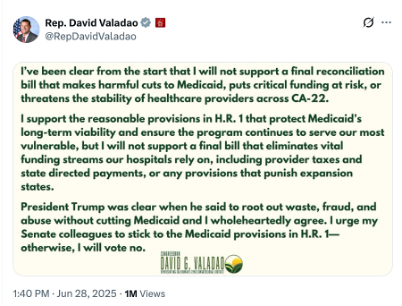
¶ Valadao Assured Constituents He Would Not Support A Final Bill That Cut Medicaid, Put Critical Funding At Risk, Or Threatened The Stability Of Healthcare Providers
Valadao Assured Constituents He Would Not Support A Final Bill That Cut Medicaid, Put Critical Funding At Risk, Or Threatened The Stability Of Healthcare Providers. According to Rep. David Valadao’s Twitter, “I’ve been clear from the start that I will not support a final reconciliation bill that makes harmful cuts to Medicaid, puts critical funding at risk, or threatens the stability of healthcare providers across CA-22. I support the reasonable provisions in H.R. 1 that protect Medicaid's long-term viability and ensure the program continues to serve our most vulnerable, but I will not support a final bill that eliminates vital funding streams our hospitals rely on, including provider taxes and state directed payments, or any provisions that punish expansion states. President Trump was clear when he said to root out waste, fraud, and abuse without cutting Medicaid and I wholeheartedly agree. I urge my Senate colleagues to stick to the Medicaid provisions in H.R. 1—otherwise, I will vote no.”
[Twitter, @RepDavidValadao, 6/28/25]
¶ 7/3/25: Valadao Voted In Favor Of the final Republican Budget Bill That would kick nearly 12 million americans off medicaid
HEADLINE: “GOP Passes Bill To Steal From The Poor And Give To The Rich.” [Daily Kos, 7/3/25]
7/3/25: Valadao Voted For The Senate FY 2025 Budget Reconciliation Bill That Extended $4 Trillion In Expiring Tax Cuts, Added New Tax Breaks, Appropriated $448 Million In Defense, Border, And Immigration Enforcement Funding, Increased The SALT Deduction To $40,000, And Cut Medicaid And Other Social Programs To Offset The Costs. In July 2025, Valadao voted for, according to Congressional Quarterly, the “motion to concur in the Senate amendment to the bill that would permanently extend nearly $4 trillion in expiring individual and business tax cuts, create several new tax breaks and fund border and immigration enforcement and air traffic control upgrades. It would cut Medicaid and other safety net programs to partly offset the cost. Among other provisions, it would raise the statutory debt ceiling by $5 trillion and appropriate more than $448 billion in mandatory funding for Trump administration priorities and other needs, including $153 billion for defense, $89 billion for immigration enforcement, and $89.5 billion for border control and security. It also would increase the state and local tax deduction cap to $40,000 annually for five years for households making up to $500,000 a year until 2030, when it would permanently revert to $10,000.” The House passed the bill by a vote of 218 to 214. [House Vote 190, 7/3/25; Congressional Quarterly, 7/3/25; Congressional Actions, H.R. 1]
- HEADLINE: "At Least 17 Million Americans Would Lose Insurance Under Trump Plan" [Washington Post, 7/1/25]
- The Congressional Budget Office Estimated That 11.8 Million People Would Become Uninsured As A Result Of The Medicaid Cuts In Republicans’ Reconciliation Bill. According to the Washington Post, "The bill, which narrowly passed the Senate on Tuesday and now heads back to the House, would effectively accomplish what Republicans have long failed to do: unwind many of the key components of the ACA, President Barack Obama’s signature domestic achievement, which dramatically increased the number of Americans with access to health insurance. To start, the Congressional Budget Office estimated that the Senate version of the bill would result in 11.8 million more uninsured in 2034, mostly because of Medicaid cuts, compared with 10.9 million if the House version became law." [Washington Post, 7/1/25]
¶ Valadao Defended His Vote For The “One Big Beautiful Bill,” Saying That It Did Not Cut Medicaid AND Suggesting CONSTITUENTS “Get Off The couch”
¶ Valadao Brushed Off Criticism About Health Care And Claimed He Was A Fighter For Preserving Medicaid
Valadao Acknowledged Criticism About Him On Health Care But Said He Had “Always Been A Fighter On This Front” And Was “Able To Be Helpful On” Medicaid. In an interview on KBAK, Rep. David Valadao said, “HOST: Now, some have criticized you when it comes to Medicare. Was this kind of a way to show constituents, your constituents, that you are committed to keeping health care costs lower in the Central Valley? VALADAO: Well, yes. I mean, a lot of the criticism is over different programs. But yes, I've always been a fighter on this front. I mean, Medicaid is something that is a huge issue in the district and it's something that we've been able to to be helpful on and fight a lot of battles on that front. But this one specific specifically is an extension that needed to be addressed. And there's an opportunity for some reforms, but making sure that health care costs don't go up, which is something that we all campaigned on, including the president. This is one of those things that we did that I think will help keep those costs down.” [KBAK, 1/12/26] (video)
Valadao Defended His Vote On The “One Big Beautiful Bill” As Preserving Medicaid Long-Term. According to CNN, "This year, Democrats are betting voters in the district — which was redrawn last year to slightly favor their party — will be equally frustrated with his vote in 2025 for President Donald Trump’s sweeping tax and spending cuts legislation, also known as the ‘One Big Beautiful Bill Act.’ […] Republicans argue that critics are misrepresenting the impact of the changes to Medicaid, which they say are meant to push able-bodied people into the workforce. […] Valadao said in a statement to CNN that the legislation was designed to preserve Medicaid long-term. ‘One of my goals representing the Central Valley is to protect Medicaid for those who truly need it the most: seniors, vulnerable children, and disabled Americans,’ the statement reads. ‘That’s why I voted to include commonsense exemptions for Californians facing serious medical issues, economic hardship, or high unemployment.’" [CNN, 5/15/26]
¶ Valadao Claimed The Rural Health Transformation Fund Would Offset Cuts To Medicaid, Despite Experts Disagreeing
Valadao Claimed Funding Placed Into The Rural Health Transformation Fund Would Offset Medicaid Cuts But Experts Note It Would Not Fully Cover Revenue Losses. According to CNN, "After the vote, Valadao said in a statement it wasn’t an easy decision, but that he’d worked to block provisions that would have been more harmful for his district. He also touted the $50 billion placed into the Rural Health Transformation Fund, a five-year grant program for states to modernize rural healthcare. The Centers for Medicare and Medicaid Services announced late last year that California would receive $233 million in 2026. Valadao appeared with the agency’s administrator, Mehmet Oz, to tout the funding earlier this year. But half of the funding will be divided equally among the states, putting larger states like California at a disadvantage. And experts note that the $50 billion fund won’t fully cover the revenue states are expected to lose." [CNN, 5/15/26]
¶ Valadao Claimed That The Bill Did Not Cut Medicaid, Rather Constituents Were “Choosing Not To Get Off The Couch” And Should “Do Something To Better Yourself”
Valadao Said It Was Dishonest To Say “One Big Beautiful Bill” Stripped Healthcare From Constituents, Saying, “We're Not Taking It Away,” But Rather “They're Choosing Not To Get Off The Couch.” According to KERO, "Valadao defended his vote on what he called the ‘One Big Beautiful’ bill, pushing back on Democratic criticism that the legislation amounted to Medicaid cuts. ‘The cuts that they're talking about again are associated with the idea that we're gonna have people who can work, no dependents, so they're not at home taking care of their kids and aren't injured, so no disabilities, they should be able to put in at least 20 hours of work or volunteer or go to school,’ Valadao said. Valadao said the characterization of the bill as stripping healthcare from constituents is dishonest. ‘We're not taking it away. They're choosing not to get off the couch,’ Valadao said." [KERO, 5/7/26]
Valadao Defended The Medicaid Cuts Contained In The “One Big Beautiful Bill” And Said That Cuts Were Only Enacted If People Did Not Do 20 Hours A Week Of Community Engagement And That Individuals Should “Do Something To Better Yourself.” According to Bakersfield Californian, “Opposition groups have focused on Valadao's vote for HR 1 and what they say will be devastating cutbacks for millions of Americans, particularly in the Central Valley where Medicaid enrollment is high. Valadao said a large portion of those cuts would only be enacted if people were not able to meet the requirement for 20 hours a week of community engagement. That's a requirement that can be filled in a number of ways, and is meant for able-bodied adults enrolled in Medicaid but not working or going to school. ‘All we're asking is that people either work 20 hours a week, volunteer or go to school. Do something to better yourself,’ Valadao said. ‘These are folks who have the ability to work and have no dependents to take care of at home. It's a reasonable ask that they put in a fair effort.’” [Bakersfield Californian, 4/27/26]
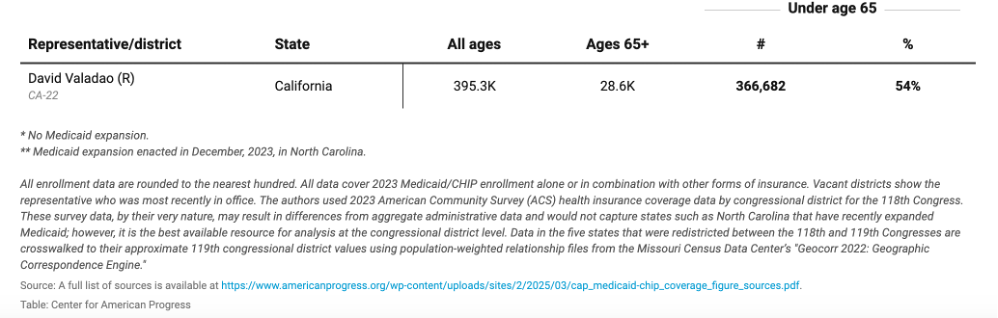
¶ More Than 65,140 Californians in the 22nd congressional district Were at-risk of losing their health coverage because of Valadao’s votes
An Estimated 65,140 Californians In The 22nd Congressional District Were At Risk Of Losing Their Health Coverage Because Of The Republican Reconciliation Bill.

[Joint Economic Committee, June 2025]
395,300 Californians In The 22nd Congressional District Were Enrolled In Medicaid.
[Center for American Progress, 3/11/25]
¶ Constituents And Experts Expressed Alarm At Impacts Of Medicaid Cuts On CA-22
A Behavioral Health Nurse And Member Of Service Employees International Union California Noted That The “One Big Beautiful Bill” Was Already Causing Reductions In Resources For Healthcare Organizations In CA-22. According to CNN, "But healthcare providers who work in the district warn that they’re already feeling the impact of Trump’s agenda bill, as hospitals and healthcare centers begin making changes to their budgets. ‘What’s happening now is that they’re facing reductions in resources, reductions in options in medications, reductions in options in physicians and programs,’ said Tina Croxton, a behavioral health nurse and member of the Service Employees International Union California, which has backed Bains." [CNN, 5/15/26]
A Community Organizer And Constituent Expressed Her Feelings Of Betrayal At Valadao’s Vote On The “One Big Beautiful Bill.” According to CNN, "For some in the district, the efforts to limit the impact of the Trump agenda bill fall short. Nataly Santamaria, a community leader — known as a promotora — in the district who helps people access health care said Valadao hadn’t done enough to explain what the path forward looks like. ‘As a constituent, because I am his constituent, I feel he betrayed us,’ she said." [CNN, 5/15/26]
HEADLINE: 'I Feel Betrayed.' Dozens Protest After Rep. Valadao Votes To Cut Medicaid. [KVPR, 5/23/25]
Think Tank Third Way Estimated Hospitals In Valadao’s District Would Lose Nearly $90 Million Annually From Medicaid Cuts, Which One Hospital Executive Called The “Foundation Of Health Care Access For Many Families.” According to Sacramento Bee, "Third Way, a self-described center-left think tank in Washington, D.C., estimated that five hospitals in Valadao’s district alone would lose nearly $90 million annually as a result of the Medicaid cuts. ‘In the Central Valley, Medi-Cal isn’t just a program, it’s the foundation of health care access for many families,’ said Kiyoshi Tomono, a marketing and partnership executive for Adventist Health, one of the largest providers of Medi-Cal in Valadao’s district." [Sacramento Bee, 3/24/26]
- An Executive From A Major Health Provider In Valadao’s District Cited Growing Concern From Rural Healthcare Providers About Impacts From The Bill. According to Sacramento Bee, "Tomono said Adventist Health, which has two hospitals and another portion of a campus in Valadao’s district, does not yet have precise estimates for how the changes will affect patient coverage or hospital finances. Still, he acknowledged growing concern about the long-term stability of rural providers stemming from the federal changes. ‘These policy changes could have significant implications for patient access, hospital stability and the long-term sustainability of rural health care infrastructure,’ Tomono said." [Sacramento Bee, 3/24/26]
A Policy Analyst From The California Budget & Policy Center: “It’s Going To Have Ripple Effects Throughout The Whole Health Care System.” According to Sacramento Bee, "The legislation was designed to take hold in phases, with some provisions already in place and others stretching into the next several years. Early changes included some cuts to providers who offer abortion services and the rollback of a federal rule that would have made it easier for children, seniors and people with disabilities to enroll and maintain coverage, said Hannah Orbach-Mandel, a policy analyst for California Budget & Policy Center. ‘I would say the most harmful provisions haven’t necessarily taken effect yet,’ Orbach-Mandel said. […] At the same time, hospitals are expected to receive less revenue tied to Medi-Cal. This could force cuts to services or staffing and lead to longer wait times, Orbach-Mandel said. ‘It’s going to have ripple effects throughout the whole health care system,’ Orbach-Mandel said." [Sacramento Bee, 3/24/26]
Kern County Was Preparing For Financial Impacts From The “One Big Beautiful Bill” On Public Health. According to KBAK, "Kern County is preparing for significant financial adjustments as the ‘Big Beautiful Bill,’ enacted in July, begins to affect local funding and services. The legislation, which was not fully considered in the initial budget signed in June, will change funding for essential services, including unpaid healthcare, SNAP program administration, and Medicaid. Elsa Martinez, assistant county administrative officer, highlighted the financial repercussions, stating, ‘The department identified $10.5 million in revenue losses. In addition, 2 million in large in already obligated but unreimbursed funds were incurred and are not likely to be reimbursed to the county. An additional $2.2 million was also impacted. And this is the future of public health. This is for the state budget.’" [KBAK, 7/29/25]
HEADLINE: Valley Hospitals, Clinics Brace For Financial ‘Tsunami’ Threatening Health Care Access. [KVPR, 2/10/26]
¶ Valadao Opposed The Affordable Care Act And Was Reluctant To Support Premium Tax Credits For Californians Struggling To Afford Healthcare
¶ Valadao CRITICIZED ACA TAX CREDITS
¶ Valadao Advocated For Limiting ACA Credits Because He Believed Congress Needed To Ensure “People Have Some Skin In The Game” In Healthcare
Valadao Advocated For Limiting ACA Tax Credits And “Making Sure That People Have Some Skin In The Game” With Co-Pays. In an interview on KBAK, Rep. David Valadao said, “HOST: And you said this is kind of like, this is a starting point towards a health care reform. What may be some of the reforms that you're looking for to kind of get this bill across the finish line VALADAO: Well, the specifics of this I mean, this is not a whole bill that covers everything in health care. This is very specific to just credits that help keep people who are on exchanges’ costs down. And so, there's about 24 million people across the country that this affects, there's a bunch here in California and a bunch of the Central Valley, thousands of them in the Central Valley. But what this bill does is it extends those tax credits to help keep some of those costs down so that people can actually afford insurance for themselves. I mean, obviously, those who are on employer-based programs, this doesn't affect them at all. It doesn't change any of the policies that we'd like to make changes to. This one is very specific, keeping those plans lower. One of those other things that we want to look at making changes is one, we want to make sure that we have an income cap on it so people who don't need these subsidies aren't getting them. And that's one of the things that we push for the most. There's also some things like a co-pay, making sure that people have some skin in the game, a very minimal number, but at least something that they have to put in themselves. And so, there are ideas out there. But there's lots of pieces of legislation out there that have moved and we do believe bills will get into the Senate proposal. And there's also things that have to do with medications and others that we've worked on. But there's things there that are in proposals that I've co-sponsored or led on. It just we need vehicles to put those in and get them to a vote.” [KBAK, 1/12/26] 260112_BGO_9324_A
¶ Valadao Historically Voted Against The ACA
2017: Valadao Voted For The American Health Care Act To Repeal The Affordable Care Act. "Both of Bakersfield's congressmen voted for the American Health Care Act Thursday as the legislation to repeal and replace the Affordable Care Act moved forward. The vote by House Majority Leader Kevin McCarthy, R-Bakersfield, was expected. The position of Rep. David Valadao, R-Hanford, was an open question until the bitter end. […] Joining in the criticism was a group of progressive activists and Democratic party stalwarts who met outside Valadao's Bakersfield office on M Street at noon Thursday. They had intended to urge him not to vote for the American Health Care Act. But just before they arrived, the news broke that the bill had passed and Valadao had supported it." [Bakersfield Californian, 5/4/17]
- Valadao Defended His Vote To Repeal Portions Of The Affordable Care Act Despite Constituent Objections. According to KGET, "Even so, he said he was proud of his votes, including some his constituents felt were controversial. He defended his vote to repeal portions of the Affordable Care Act, also known as Obamacare. ‘I wouldn’t change it for anything. One of the things that [the] Affordable Care Act has done is raised our rates quite a bit. Even in my short time in office, my rates have doubled. Nothing has been done to fix that.’" [KGET, 12/18/18]
2014: Valadao Voted To Repeal The Affordable Care Act, As Part Of Rep. Paul Ryan’s Budget Proposal. In April 2014, Valadao voted to repeal the Affordable Care Act, as part of House Budget Committee Chairman Paul Ryan’s (R-WI) proposed budget resolution covering fiscal years 2015 to 2024. According to The Hill, “Rep. Paul Ryan’s final House budget includes a full repeal of ObamaCare. […] Ryan did not lay out the parameters of a replacement, or say what would happen to those who have already obtained coverage under the new healthcare law. But Ryan, seen as a future GOP White House hopeful, said the law was a ‘costly mistake’ that needed to be replaced.” The House adopted the budget resolution by a vote of 219 to 205, but the Senate did not. [House Vote 177, 4/10/14; The Hill, 4/1/14; Congressional Actions, H. Con. Res. 96]
2013: Valadao Voted For Repealing The Affordable Care Act As Part Of The FY 2014 Ryan Budget. In March 2013, Valadao voted for repealing the Affordable Care Act, as part of House Budget Committee Chairman Paul Ryan’s (R-WI) proposed budget resolution covering fiscal years 2014 to 2023. According to the House Budget Committee, the budget would “Repeal the President’s health-care law.” The resolution passed the House by a vote of 221 to 207, but died in the Senate. [House Vote 88, 3/21/13; House Budget Committee, 3/12/13; Congressional Actions, H. Con. Res. 25]
- Ryan’s Budget Eliminated ACA’s Independent Payment Advisory Board, Costing The Government $3.1 Billion Over Ten Years. According to the text of Ryan’s Budget, “additional cuts from the IPAB board will force even more health care providers to close their doors, and the Board should be repealed.” According to CRS, “Under current law, beginning in 2014, the IPAB is required to develop proposals to reduce the Medicare per capita expenditure growth rate if Medicare spending is projected to exceed a certain target. CBO estimates that the repeal of IPAB would cost $3.1 billion over 10 years.” [CRS, 3/29/12]
- Ryan’s Budget Retained The Tax Increases In The ACA. According to the Heritage Foundation, “But, as noted above, perhaps the biggest shortcoming of this budget is that it keeps the tax increases associated with Obamacare. These tax hikes are the oxygen that fuels the fire of ever bigger spending. But the entire fire needs to be put out—all of Obamacare should be repealed, including its tax hikes.” [Heritage Foundation, 3/12/13]
- Valadao Touted His Vote To Strip Funding From The Affordable Care Act. According to Fresno Bee, "Members of the San Joaquin Valley's congressional delegation toed their respective party lines on Friday's vote on a bill to extend federal spending for 10 weeks beyond Sept. 30 while also eviscerating President Barack Obama's Affordable Care Act. […] Valadao touted his vote to prevent a government shutdown while also stripping money for the health-care law." [Fresno Bee, 9/20/13]
¶ Valadao Highlighted The Importance Of ACA Tax Credits For His District When Talking About The Expiration Of Credits He Had Criticized
Valadao Claimed The “Last Thing” Struggling California Families Needed Were Sudden Spikes In Health Insurance Costs. According to Sacramento Bee, "House Speaker Mike Johnson, R-La., has not ruled out continuing the subsidies, and Friday got a push from members of both parties who proposed legislation to continue them. They included David Valadao, R-Hanford, who could be vulnerable in next year's election. He's seeking a one-year extension of the premium aid while Congress seeks a more permanent solution. ‘Too many hardworking families across California are already struggling with health care costs, and the last thing they need is a sudden spike in their health insurance premiums,’ said Valadao." [Sacramento Bee, 9/8/25]
Valadao Highlighted That Health Care Played A Larger Role In His District Than For Other Representatives. According to David Valadao on KGET, “VALADAO: I just represent a district that is a little bit different than a lot of my colleagues, and each one of us has to vote our districts. You got people in different parts of the state that have their own concerns, but mine, health care plays a big role.” [KGET, 1/12/26] (video)
Valadao Recognized The ACA Cliff Months Before Voting To Extend Subsidies. According to David Valadao on KFSN, “ANCHOR: Action News spoke with Valley Congressman David Valadao, who broke party lines and cast a yes vote lines and cast a yes vote. VALADAO: It's thousands of people and it's something that we've been watching closely. I've been bringing it up to my leadership, the speaker and the whip and the majority leader for a good six, seven months now and frustrated that they wouldn't work with us to come up with some sort of commonsense proposal. So, we started working with the Senate and we looked for a vehicle to send over there. ANCHOR: The legislation, now heads to the Senate where it's unlikely to receive a vote. Senate Majority Leader John Thune said today, quote, ‘There's no appetite to do a straight up extension. We've had that vote.’” [KFSN, 1/8/26] (video)
Valadao Emphasized That His District Were Going To Experience A More Significant Uptick In Insurance Prices Than Anywhere Else If ACA Tax Credits Expired. In an interview with Trevor Carey, David Valadao said, “HOST: All right. I'm going to come full circle here. Thank you for your time. But you said something at the very start, 265% increase for constituents in your district. What causes that? VALADAO: That's an interesting question. I have not been able to get there because to get the exact information, we've been looking. We've been reaching out to the administration to get better numbers on that. Because when you look at different districts in Florida, they have a much higher population of members, that have, in members districts have some of those guys that 37% of their districts and 38% of their districts are affected by this. But their increases are only like 60% and 100% and 150%. I have the highest increase of anyone in the country, and we haven't got an exact answer from anyone in the administration or across the street in the industry to tell us, here's the reason why yours is so bad. HOST: I have no idea. Shot in the dark – are there are a lot of doctors that would rather work with private insurance people, and that's less doctors that are accepting this. And when there's less doctors, they charge more? VALADAO: It might be because I have a poorer district and they’re, they’re subsidized at a higher rate and other people's districts are wealthier and they don't get as much.” [KFIV with Trevor Carey, 1/8/26] (audio)
¶ Valadao Pointed Out The Electoral Consequences Of Not Doing Something About High Healthcare Prices When Asked About The Expiration Of ACA Tax Credits
Valadao Claimed That Increasing Healthcare Costs Could Impact Republicans When Asked About The Political Implications Of ACA Tax Credit Fights. According to CNN, "Anxiety is rising among congressional Republicans that their party has no plan to address a critical health care deadline this fall that will result in spiking costs for millions of Americans – the issue at the heart of the deepening government shutdown crisis. And some of those GOP members are offering a stark warning to their own leaders: Doing nothing could cost them their full control of Congress in next November’s midterms, calling for a plan that would address expiring enhanced Obamacare tax credits to be swiftly advanced once the government eventually reopens. ‘I think the reality is, if costs go up under our control, it could have an impact on us,’ Rep. David Valadao, a vulnerable GOP lawmaker from California, told CNN about the political effects of the health care fight. ‘I get that there’s some in leadership who don’t like hearing it but there’s no denying it.’ ‘Just watching rates go up and pointing fingers is not what we should be doing in our position,’ he said." [CNN, 10/26/25]
¶ December 2025: Valadao voted for a bill that would weaken protections for people with pre-existing conditions and failed to address premium spikes
¶ December 2025: Valadao Voted For The Lower Health Care Premiums For All Americans Act
2025: Valadao Voted For The Lower Health Care Premiums For All Americans Act That Allowed The ACA Tax Credits To Expire. In December 2025, Valadao voted for, according to Congressional Quarterly, “the bill that would expand the ability of small businesses to establish association health plans and bars states from preventing small businesses from obtaining stop-loss insurance for self-funded health insurance plans. It would codify and expand rules governing employer-funded health reimbursement arrangements and would allow employees in such arrangements to pay Affordable Care Act health insurance premiums through salary reductions. It would provide funding for ACA policy cost sharing reduction payments that reduce deductibles and copayments. It would prohibit plans from providing abortion-related care. It also would require pharmacy benefit managers to provide transparency regarding prescription drug costs and the drug rebates they receive.” The vote was on passage. The House passed the bill by a vote of 216 to 211. [House Vote 349, 12/17/25; Congressional Quarterly, 12/17/25; Congressional Actions, H.R. 6703]
¶ The Lower Health Care Premiums For All Americans Act Did Nothing To Address The Expiration Of ACA Enhanced Premium Tax Credits And Would Weaken Protections For People With Pre-Existing Conditions
The December 2025 Republican Health Care Bill Failed To Prevent Imminent Premium Spikes For More Than 20 Million People Who Relied On ACA Marketplace Plans. According to the Center on Budget and Policy Priorities, "The health bill House Republicans are preparing to bring to the floor this week not only fails to prevent imminent premium spikes for more than 20 million people in marketplace plans, but would raise costs even higher for many marketplace enrollees and weaken pre-existing condition protections for individuals and small businesses." [Center on Budget and Policy Priorities, 12/16/25]
- HEADLINE: "House Republicans Pass Health Care Plan Without Re-Upping Insurance Subsidies" [Politico, 12/17/25]
- HEADLINE: "House Passes GOP Health Bill Without Subsidies" [Axios, 12/17/25]
- HEADLINE: "House Passes GOP Health Care Bill Without Obamacare Subsidy Extension" [The Hill, 12/17/25]
- HEADLINE: "House Passes GOP Health Care Bill Without ACA Extension" [CBS News, 12/17/25]
The December 2025 Republican Health Care Bill Would Expand Association Health Plans, Which Would Result In Higher Underlying Premiums For Individuals And Small Businesses That Remained In ACA-Regulated Markets. According to the Center on Budget and Policy Priorities, "It would expand association health plans (AHPs), a type of health plan that trade associations, professional groups, and other organizations may offer their members, to cover self-employed individuals and small businesses as if they were large employers. By allowing more people to enroll in coverage not subject to ACA standards and consumer protections, this would segment insurance risk pools: individuals who are younger and healthier, or small businesses with younger or healthier employees, could get plans with lower premiums because they would be priced separately from ACA-compliant coverage and wouldn’t have to meet ACA standards such as having to cover a set of essential health benefits. As a result, individuals and small businesses remaining in ACA-regulated markets would see higher underlying premiums." [Center on Budget and Policy Priorities, 12/16/25]
The December 2025 Republican Health Care Bill Would Likely Lead To Higher Premiums For Older And Sicker Small Groups And Self-Employed People, Thereby Undermining Protections For People With Pre-Existing Conditions. According to the Center on Budget and Policy Priorities, "In addition, the bill would undermine protections for people with pre-existing conditions. While it would bar AHPs from rejecting individuals or charging them more based on certain health factors, it would give them greater ability to base a small group’s or self-employed person’s costs on their health risk compared to individual or small-group coverage. This would likely lead to higher premiums for older and sicker small groups and self-employed individuals, making such arrangements more attractive to healthier individuals and groups." [Center on Budget and Policy Priorities, 12/16/25]
¶ January 2026: Valadao’s Reluctant vote to extend enhanced aca premium tax credits came too late and premiums spiked for Californians
¶ Valadao Voted For The Temporary Extension Of Affordable Care Act Tax Credits
1/8/26: Valadao Voted For Extending The Affordable Care Act Tax Credits For Three Years. In January 2026, Valadao voted for, according to Congressional Quarterly, “the bill, as amended, that would extend for three years, through the end of calendar year 2028, the enhanced tax credits to subsidize premiums for health insurance purchased on the Affordable Health Care Act health insurance markets. It would allow taxpayers whose household income exceeds 400 percent of the federal poverty line to receive tax credits for three more years. The measure would retroactively take effect Jan. 1, 2026.” The vote was on passage. The House passed the bill by a vote of 230 to 196. [House Vote 11, 1/8/26; Congressional Quarterly, 1/8/26; Congressional Actions. H.R. 1834]
- 17 Republicans Voted For Passage Of The “Clean” Extension, Following A Procedural Vote The Day Before That Had Support From Nine Republicans. According to Politico, “Seventeen Republicans joined Democrats in passing legislation Thursday that would revive enhanced Affordable Care Act subsidies for three years, rebuffing opposition from GOP leadership. The 230-196 vote follows a procedural vote Wednesday to advance the bill, where nine Republicans joined Democrats in favor of moving forward.” [Politico, 1/8/26]
- Speaker Johnson Called The Bill “Really Bad Policy” And Said He Wished That Not Everyone Had A Vote. According to Politico, “Johnson’s office, in a last-ditch effort Thursday morning to undermine the effort, blasted out a memo accusing ‘Democrats [of] want[ing] to expand a COVID subsidy system already flagged for massive fraud and abuse, with absolutely zero reforms.’ After the vote Thursday evening, Johnson said in an interview of the Republicans who defected, ‘I think it’s a really bad policy, and I wish they hadn’t, but everybody had a vote.’” [Politico, 1/8/26]
¶ Valadao Stated He Only Voted For The ACA Extension Because He Did Not Think The Senate Would Pass It
Valadao Voted To Extend Credits Only Because He Did Not Think The Bill Would Pass The Senate. In an interview on KBAK, Rep. David Valadao said, “HOST: And recently you were one of the 17 Republicans that joined Democrats to keep the Obamacare tax credits going for three years. Was there a reason why you broke from Speaker Johnson to vote to keep these tax credits continuing for another three years? VALADAO: […] But the piece of legislation I voted on the other day, one, I don't believe it's going to become law in its current form, but what it did do is it created an avenue for us or a vehicle to send to the Senate and send back to us in the House. Ultimately to hopefully continue some sort of extension, but making sure that there are some reforms so there's no fraud and obviously making sure that people have a program that helps those who need it and prevent the dollars from being wasted that on people who don't.” [KBAK, 1/12/26] (video)
Valadao Claimed He Did Not Think The ACA Tax Credit Bill Would Pass As Is. In an interview on KBAK, Rep. David Valadao said, “HOST: Is there anything, any way you might be working with colleagues in the Senate to kind of ensure that this bill eventually does get passed, you find a bipartisan measure for health care? VALADAO: Yeah. The day of the actual final vote, I actually met with about five or six senators. A group from the House and a group of Senate got together for about an hour or two and actually talked about what was possible. And we feel pretty positive that there's an opportunity there. But the bill in its current form is not going to move forward. Ultimately, there has to be changes and if there's not changes it ultimately dies, if the changes are good enough, it passes both Houses, then we'll have to see if the president will even sign it. I think that if it passes both Houses, I absolutely believe the president would sign it because he's his administration has actually voiced some support for a lot of the things that we've talked about.” [KBAK, 1/12/26] (video)
Valadao Admitted That He Did Not Like Parts Of The ACA Extension But Passed It So It Would Move To The Senate Because He Didn’t “Believe That For A Second” The Current Bill Would Pass The Senate. In an interview with Trevor Carey, David Valadao said, “HOST: It does. I see if I'm picking up what you're throwing down here, I got a few questions, but basically, I heard you went to lunch with some senators. So if I'm going to jump into your DC mindset here, tell me if I'm right or wrong. There were things in it you hated, but you knew I had lunch with some dudes that are going to fix it, so I'm just go pass it off to them, vote on that. And you're hoping that they follow through with what they said. VALADAO: Well, that's what we've done on lots of legislation over the years. And usually it's not this high profile, but yes, it is very normal for us to send legislation over to the Senate and they send it back. I mean, we just passed some appropriations bills. We sent it to the Senate. It came out of committee looking like one thing, it gets to the floor. It moves over to the Senate. They sent it back. And because the Senate needs 60 votes, it's always a little bit more difficult, putting something in their hands so they can mess with it allows us the process to move things forward. And so, I mean, do I think something will become law? I kind of do, but it's not going to be what we passed today. I don't believe that for a second, really.” [KFIV with Trevor Carey, 1/8/26] (audio)
Valadao Voted To Extend Subsidies Knowing The Bill As Is Would Not Pass The Senate, And Hoped Instead A Bill Would Require Everyone To Pay Some Premium And Shrink The Number Of People Who Received ACA Tax Credits, Despite Acknowledging Their Importance To His District. In an interview with Trevor Carey, David Valadao said, “VALADAO: We weren't getting enough support and the leadership had promised us a vote, then they kind of dropped the ball on it and so fine. We met with some senators, a bipartisan group of senators on both sides of the aisle, said we think we can get a deal done, send us a bill. And so we sent them a bill. Hopefully they reform it. When I met with some senators today at lunch time, they think they can get something with a cap on people that can get this benefit. So it'll help people, especially people in my district. I represent a very poor district, but making sure that people pay at least something out of pocket. So $5, at least a minimum premium, $60 a year, and making sure that holding the insurance companies accountable, anyone that’s doing things wrong. And so we'll see what the Senate does with it. But this bill, just because it passed the House floor, does not mean it becomes law. The fact is, no one in Washington believes it will become law in its current form. We're just hoping that by sending it to the Senate, the Senate will take it up, fix it, and they can get something that Republicans will support and send it back to us. And a few of us took a tough vote. It's not popular, but in reality, this affects 24 million people across the country, once they get some of the reforms in place, that number will obviously shrink. But it's an issue that I think even the president I mean, the president's comments were we need to address this, but he doesn't want to give the money to insurance companies, he wants to give it to HSA’s. We think that options is available in the Senate. We'll see what they send back to us to see if it's something more palatable. But I mean, the president's not going to sign that piece of legislation and we're just going through the legislative process right now. Does that explain it pretty well?” [KFIV with Trevor Carey, 1/8/26] (audio)
¶ Valadao Claimed Sending The Bill To The Senate Would Result A Different Bill That Would “Make Less People Angry At Me”
Valadao Claimed He Hoped Sending The ACA Extension Bill To The Senate Would Result In Something That Would “Make Less People Angry At Me.” In an interview with Trevor Carey, David Valadao said, “VALADAO: But we've got a problem here. It needs to be addressed. Let's have that conversation. Let's move the bill. Even if I don't like what I voted for today, hopefully something comes back that will make less people angry at me.” [KFIV with Trevor Carey, 1/8/26] (audio)
¶ Valadao’s Delay Created A Dramatic “Subsidy Cliff”
The Expiration Of Enhanced ACA Premium Tax Credits Created A “Subsidy Cliff” Whereby If Households Earned Even $1 More Than A Specific Income Threshold They Could Lose All Eligibility For Assistance. According to CNBC, "For the first time in years, many Americans enrolled in a health insurance plan via the Affordable Care Act marketplace will need to keep a careful accounting of their annual income — or risk a hefty federal tax bill. Enhanced ACA subsidies lapsed at the end of 2025, leaving millions of households on the hook for higher insurance premiums. The lapse also reintroduced the so-called subsidy cliff, whereby households that earn even $1 more than a specific income threshold will lose all eligibility for subsidies, also known as premium tax credits. That income cutoff, which varies by family size, is $62,600 for a single person, $84,600 for a two-person household and $128,600 for a family of four in 2026, for example." [CNBC, 1/6/26]
- More Than Two Million Americans Had Incomes Near A “Subsidy Cliff.” According to CNBC, "More than 2 million people enrolled in an ACA marketplace plan have an income near the subsidy cliff. ACA enrollees also tend to have relatively volatile incomes, making it hard to predict their annual earnings, experts said." [CNBC, 1/6/26]
Households That Went Over The Income Limit Would Have To Pay Back Any Federal Assistance They Received For Premiums, Which Could Cost Thousands Of Dollars, When They Filed Their Taxes. According to CNBC, "Households over the limit would have to pay back any federal subsidies they received for premiums — potentially worth thousands of dollars — when they file taxes next year for 2026." [CNBC, 1/6/26]
Republicans’ Big Beautiful Bill Exacerbated The Problem By Stripping Away Guardrails Capping The Amount Of Excess Subsidies Households Are Required To Repay. According to CNBC, "The potential financial impact is exacerbated by a multitrillion-dollar legislative package known as the ‘big beautiful bill’ that Republicans passed over the summer, which stripped away guardrails capping the amount of excess subsidies households must repay, experts said." [CNBC, 1/6/26]
¶ 22 Million Americans Relied On ACA Premium Tax Credits To Afford Health Insurance
Approximately 22 Million Americans Relied On ACA Premium Tax Credits To Afford Health Insurance. According to CNBC, "About 22 million Americans received premium subsidies, also known as premium tax credits, in 2025. Households can opt to receive the tax credit in one of two ways: As a lump sum during tax season or as an advanced payment. Under the latter option, by far the most popular, the federal government issues the tax credit directly to a consumer’s insurer, which then lowers the consumer’s out-of-pocket premium. Consumers receive those advanced ACA subsidies based on an estimated annual income they provide when signing up for insurance. They must reconcile those subsidies during tax season and repay any excess tax credits to the IRS." [CNBC, 1/6/26]
¶ Residents In CA-22 Were Already Experiencing Negative Impacts Of Tax Credits Expiring
As Of March 2026, Almost 27,000 Residents In The San Joaquin Valley Had Their Health Insurance Terminated Due To Expiration Of Health Insurance Credits.

[Central Valley Journalism Collaborative Health Equity Reporting Lab, Covered California Coverage Terminations In The Valley, viewed 8/3/26]
Healthcare Premiums Per Person For Lower- And Middle-Income Californians In The San Joaquin Valley Increased By Hundreds Or Thousands Of Dollars Per Person Annually.

[Central Valley Journalism Collaborative Health Equity Reporting Lab, Premium Increases For Covered California Health Coverage, viewed 8/3/26]