¶ President Trump And Speaker Johnson Both Endorsed Casey Askar For Congress
Trump Endorsed Askar For Congress, Claiming Askar “Will Never Let You Down.” According to a post from Donald Trump’s Truth Social account,
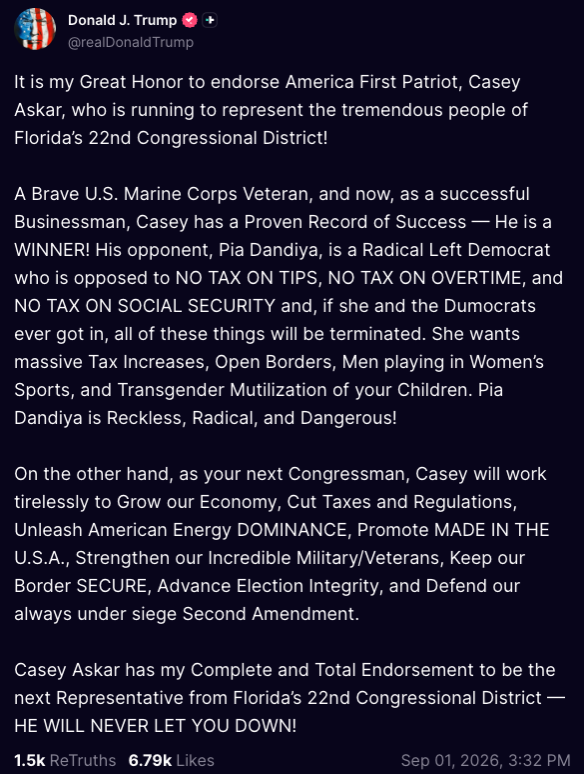
[Truth Social, @realDonaldTrump, 9/1/26]
Speaker Mike Johnson Endorsed Askar For Congress, Claiming Askar Would Help “Grow Our House Republican Majority And Continue Our American Comeback.” According to a post from Speaker Mike Johnson’s on Twitter,
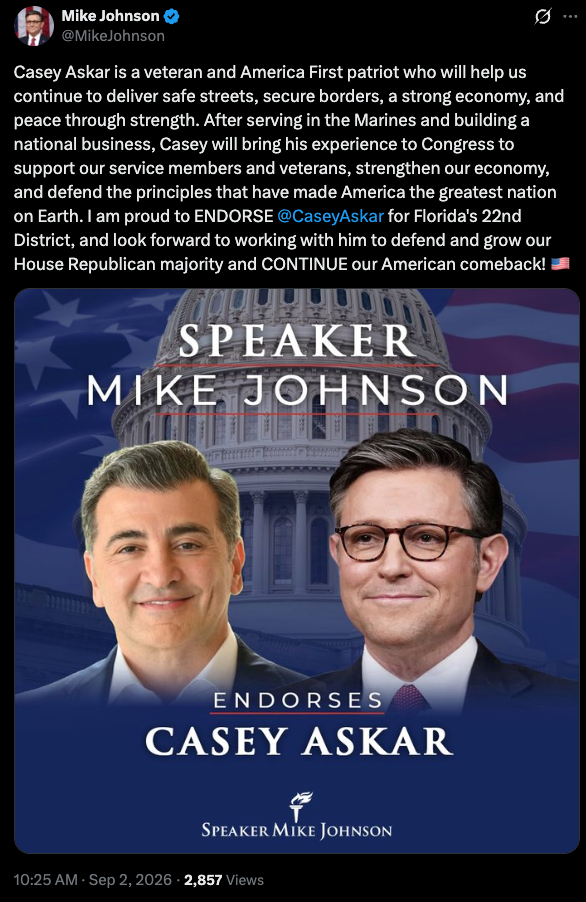
[Twitter, @MikeJohnson, 9/2/26]
¶ Askar Claimed To Be A “Strong, Loyal Ally Of President Trump” Who Has “Always Voted, Supported, Donated To President Trump”
Askar Claimed He Was A “Strong, Loyal Ally Of President Trump” Who Has “Always Voted, Supported, Donated To President Trump.” According to a video posted by Casey Askar, “ASKAR: I’m a strong, loyal ally of President Trump. I’ve always voted, supported, donated to President Trump.” [Casey Askar, YouTube, 7/20/26] (video)
¶ Askar Said He Would “Work With Leadership” To Address The “Affordability Crisis”
Askar Said “We Are All Feeling The Pressure” Of Higher Prices And He Would “Work With Leadership To Help Slash Overburdening Taxes And Regulations That Are Adding To The Affordability Crisis. According to Casey Askar for Congress, “We are all feeling the pressure at the grocery store and at the gas pump. Tackling the rising cost of eggs, milk, and gas is hist top priority. In Congress, Casey will work with leadership to help slash overburdening taxes and regulations that are adding to the affordability crisis.” [Casey Askar for Congress, viewed 9/15/26]

¶ Speaker Mike Johnson Fought To Protect Trump’s Costly Tariffs
¶ February 2026: Johnson Worked To Prevent Trump’s Tariffs From Being Voted Down In Congress
Johnson’s Procedural Maneuver To Prevent A Vote Blocking Trump’s Tariffs Failed After Three Republicans Defected Against Johnson And Trump. According to Axios, "House Speaker Mike Johnson (R-La.) has repeatedly blocked these votes over the past year, but his attempt to do so on Tuesday was thwarted by a trio of Republican defectors in a late-night vote. Johnson's procedural maneuver to stop Democrats from forcing votes to end Trump's tariffs under the National Emergencies Act failed 214 to 217, with Reps. Don Bacon (R-Neb.), Kevin Kiley (R-Calif.) and Thomas Massie (R-Ky.) breaking away." [Axios, 2/11/26]
- HEADLINE: “House Defeats Republican Bid To Block Votes On Trump’s Tariffs” [New York Times, 2/10/26]
- The House Adopted A Rule In March Of Last Year Barring Tariff Challenges That Expired In January, Resulting In Speaker Johnson Calling Another Extension, Through This Rule, “Necessary.” According to Reuters, “Earlier in the day, Johnson told reporters that he expected the measure to pass the House, calling it necessary in view of an expected Supreme Court ruling on the legality of the tariffs. House Republicans first adopted a rule barring tariff challenges last March and later extended it through January.” [Reuters, 2/11/26]
- The Rule That Barred Tariffs Challenges Blocked Democrats From Repealing Trump’s Declared National Emergency That Allowed For His Broad Tariffs. According to the Hill. “Trump declared national emergencies as a basis for implementing his broad-based global tariffs, as well as specific tariffs on China, Mexico and Canada. The National Emergencies Act dictates that Congress can use joint resolutions to repeal a national emergency, and outlines procedures to expedite that action after a certain number of calendar days. Multiple times last year, GOP leaders inserted language into procedural rule legislation to not count a ‘calendar day’ for the purposes of the National Emergencies Act until a specific date, blocking members from forcing action to repeal the tariffs. That prohibition expired at the end of January as GOP leaders faced resistance from Republicans. The latest attempt would have reinstated that prohibition until July 31, 2026.” [Reuters, 2/11/26]
- Johnson Delayed The Vote To Ban Members From Blocking Tariffs From 1:30 PM To 8:30 PM In An Attempt To Flip Votes. According to the Hill, “Speaker Mike Johnson (R-La.) was unable to win over the holdouts, despite delaying the vote from 1:30 p.m. to 8:30 p.m.” [The Hill, 2/10/26]
¶ September 2025: Johnson Made Sure Republicans Voted To Protect Trump’s Tariffs
Johnson Convinced Republican Members To Vote To Prohibit Recall Votes On Trump’s Tariffs. According to The Hill, "The House previously voted to prohibit recall votes on some tariffs until Sept. 30 and on others to the end of the calendar year, while Tuesday’s rule extended that prohibition to March 31, 2026. Leaders including Speaker Mike Johnson (R-La.) and House Majority Leader Steve Scalise (R-La.) huddled with the three California Republicans and Bacon as they aimed to convince them to switch their votes, as Massie and Spartz — two members who have often broken with GOP colleagues on spending matters — were across the House floor, not part of the negotiation." [The Hill, 9/16/25]
- Johnson And GOP Leadership Won Support From Holdouts By Promising The Shortern The Block On Tariff Disapproval Votes. According to Politico, “GOP leaders flipped several of the Republican holdouts with a promise to add language shortening the block on tariff disapproval votes to a forthcoming measure set for approval later in the week, per two Republicans with direct knowledge of the agreement. The expiration date on the block will be reset from March 31 to the end of January, House Majority Leader Steve Scalise said Tuesday. It’s likely the Supreme Court will have ruled on a challenge to Trump’s tariff-declaring powers by then.” [Politico, 9/16/25]
- September 2025: House Republicans Voted In Favor Of A Measure That Effectively Blocked Challenges To Trump’s Tariffs Through March 2026, With The Intent Of Changing The Length Of Time To January 2026. According to Politico, "House Republicans voted in near lockstep Tuesday to again cede congressional power over tariffs to President Donald Trump. A measure that effectively blocks challenges to Trump’s sweeping global tariff declarations through March 2026 was adopted on a 213-211 vote. The vote was gaveled down only after GOP whips had a drawn-out struggle on the floor with a band of Republicans who initially opposed the legislation before flipping to yes. The vote was held open for more than a half-hour as they worked to bring the members back on board. GOP leaders flipped several of the Republican holdouts with a promise to add language shortening the block on tariff disapproval votes to a forthcoming measure set for approval later in the week, per two Republicans with direct knowledge of the agreement. The expiration date on the block will be reset from March 31 to the end of January, House Majority Leader Steve Scalise said Tuesday. It’s likely the Supreme Court will have ruled on a challenge to Trump’s tariff-declaring powers by then." [Politico, 9/16/25]
¶ April 2025: Johnson Shielded Trump’s Tariffs From Legislative Opposition
4/9/25: Johnson Pushed Forward A Measure That Made It Harder For Any Opposition Efforts To Strike Down Trump’s Tariffs. According to Business Insider, "House Speaker Mike Johnson and GOP leaders on Wednesday moved to make it harder for challenges to President Donald Trump's Liberation Day tariffs to succeed. Republican leaders tucked in a provision in an unrelated measure that would forestall challenges to the underlying national emergency Trump used to unilaterally impose sweeping tariffs on Liberation Day. […] The House passed the procedural measure on a 216 to 215 vote. Three Republicans, Reps. Thomas Massie of Kentucky, Victoria Spartz of Indiana, and Mike Turner of Ohio voted against it. Effectively, Johnson and his fellow Republicans have shielded Trump's trade policies amid grumbling from Republicans on both sides of the Capitol. Seven GOP senators are backing an unrelated bill to curb presidential tariff policy. Trump has promised to veto that legislation." [Business Insider, 4/9/25]
- Speaker Johnson Backed The Move, Claiming Trump Has “Executive Authority” And That The Tariffs Are “In The Interest Of The American People.” According to ABC News, “House Speaker Mike Johnson, R-La., defended the move, telling reporters, ‘I've made it very clear I think the president has executive authority. It's an appropriate level of authority to deal with the unfair trade practices. That's part of the role of the president is to negotiate with other countries.’ Johnson said Trump told him Tuesday night that ‘there are almost 70 countries that are [in] some stage in negotiation of more fair-trade agreement agreements with the United States. I think that is in the interest of the American people. I think that is an ‘America First’ policy that will be effective, and so we have to give them the space to do it.’” [ABC News, 4/9/25]
- The Vote Was The Second Use Of The Procedural Tactic To Block Votes On The Tariffs, The First Use Of It Being In March 2025. According to ABC News, “House Democrats, led by Rep. Gregory Meeks, D-N.Y., moved to force a vote on Tuesday on terminating the national emergency authority and blocking Trump's sweeping tariffs. Now, that vote is unlikely to occur. This is the second time Johnson has moved to stop the legislative calendar to prevent votes on Trump's authority on tariffs. Under House rules, these votes would typically come up within 15 calendar days but now will not if the ‘rule’ passes during the vote series Wednesday afternoon.” [ABC News, 4/9/25]
¶ March 2025: Johnson Helped Protect Trump’s Tariffs From Challenges In Congress
After House Republicans Voted To Block The Ability Of Congress To Challenge Trump’s Tariffs, Johnson Claimed It Was Because Republicans “Trust[Ed] This White House To Do The Right Thing.” According to Reuters, "The Republican-controlled U.S. House of Representatives voted on Tuesday to block the ability of Congress to quickly challenge tariffs imposed by President Donald Trump that have rattled financial markets. The 216-214 vote, largely along party lines, delays lawmakers' ability for the rest of the year to force a vote that could revoke Trump's tariffs and immigration actions. […] ‘This is an appropriate balance of powers and we trust this White House to do the right thing, and I think that was the right vote and it was reflected in the vote count,’ House Speaker Mike Johnson said when asked by Reuters why he was comfortable giving more trade power to the executive branch. The provision was tucked into a procedural vote related to the Republicans' six-month stopgap funding bill." [Reuters, 3/11/25]
- The Bill Effectively Blocked The House From Voting To Reverse Trump’s Tariffs On Mexico, Canada, And China. According to the New York Times, “Republican leaders on Tuesday slipped language into a procedural measure that would prevent any resolution to end the tariffs on Mexico, Canada and China from receiving a vote this year. It passed on party lines as part of a resolution that cleared the way for a vote later Tuesday on a government spending bill needed to prevent a shutdown at the end of the week.” [New York Times, 3/11/25]
- The Bill Nullified A Law That Would Allow The House And Senate To End A Disaster Declared By The President. According to the New York Times, “In this case, Republican leaders did so using a particularly unusual contortion: They essentially declared the rest of the year one long day, nullifying a law that allows the House and Senate to jointly put an end to a disaster declared by the president.” [New York Times, 3/11/25]
- The National Emergencies Act Required Consideration Of Resolutions Ending A Presidential Emergency Within Fifteen Calendar Days, But Republican Leadership Included A Measure In The Bill Declaring Each Day For The Remainder Of The 119th Congress Would Not Constitute A Calendar Day. According to the New York Times, “The national emergency law lays out a fast-track process for Congress to consider a resolution ending a presidential emergency, requiring committee consideration within 15 calendar days after one is introduced and a floor vote within three days after that. But the language House Republicans inserted in their measure on Tuesday declared that, ‘Each day for the remainder of the 119th Congress shall not constitute a calendar day’ for the purposes of the emergency that Mr. Trump declared on Feb. 1.” [New York Times, 3/11/25]
¶ Trump’s Tariffs Were Causing “Mega-Layoffs” Across The Country And Raising Prices In Florida
¶ 2025: Trump’s Tariffs Led To Layoffs
October 2025: Employers Cut 153,000 Jobs In A Series Of “Mega-Layoffs.” According to the Washington Post, “‘We’re entering new territory with these layoffs in October,’ said John Challenger, CEO of the consulting firm that tracks job losses. ‘We haven’t seen mega-layoffs of the size that are being discussed now — 48,000 from UPS, potentially 30,000 from Amazon — since 2020 and before that, since the recession of 2009. When you see companies making cuts of this size, it does signal a real shift in direction.’ (Amazon founder Jeff Bezos owns The Washington Post.) Recent layoffs, the data shows, have been concentrated in technology, retail, service and warehousing jobs. Employers announced more than 153,000 job cuts last month, a 183 percent increase from the month before, marking the worst October for layoffs since 2003, the Challenger report said.’” [Washington Post, 11/6/25]
- Bloomberg Reported Corporations Have Cited Tariffs As A Reason For Layoffs. According to Bloomberg, “US companies announced the most job cuts for any October in more than two decades as artificial intelligence reshapes industries and cost-cutting accelerates, according to data from outplacement firm Challenger, Gray & Christmas Inc. … Others are focused on removing layers of management, reducing the hangover from the pandemic-fueled hiring bloat and protecting profit margins from the added costs of tariffs. While many expected increased levies to drive up prices, many employers have absorbed the price increases and instead chosen to cut costs from labor and other parts of their businesses.” [Bloomberg, 11/6/25]
¶ Tax Foundation Found Trump’s Tariffs Amounted To A $1,000 Tax Increase On Americans In 2025
Tax Foundation Found Trump’s Tariffs Amounted To A $1,000 Tax Increase On Americans In 2025 And Was Projected To Be A $1,300 Tax Increase On Americans In 2026. According to the Tax Foundation, "President Trump has imposed International Emergency Economic Powers Act (IEEPA) tariffs on US trading partners, including China, Canada, Mexico, and the EU. In addition, he has threatened and imposed Section 232 tariffs on autos, heavy trucks, steel, aluminum, lumber, furniture, semiconductors, pharmaceuticals, and copper, among others. The Trump tariffs amount to an average tax increase per US household of $1,000 in 2025 and $1,300 in 2026." [Tax Foundation, 2/6/26]
¶ 2025: Trump’s Tariffs Led To Increased Prices For Florida Consumers
Florida Economics Experts Feared Trump’s Tariffs Would Have Significant Short-Term Impacts On Florida. According to WUSF, “President Donald Trump has flirted with implementing sweeping international tariffs for months. His latest plan includes enacting at least a 10% tariff on all counties starting August 1st. Economics experts are saying those tariffs could have significant short-term impacts on Florida and its residents. Randall Holcombe, an economics professor at Florida State University, worries Trump's plan will lead to rising costs for Floridians. ‘Tariffs essentially, it's a tax on American consumers, and it's politically motivated by companies, domestic companies who want protection from foreign competition,’ he said. ‘The same thing applies to foreign countries. They'll put tariffs on American goods because the foreign manufacturers don't want American competition in their domestic markets.” [WUSF, 7/13/25]
A Florida-Based Taxpayer Research Institute Reported That Grocery Prices Could Go Up 10 To 15 Percent As A Result Of Trump’s Tariffs. According to WUSF, “Florida TaxWatch, a Tallahassee-based taxpayer research institute, recently released a report that found tariffs could impact costs across products in Florida. They project the price of new cars could go up at least $6,000 - $7,000. Grocery bills could go up 10 to 15%. Dominic Calabro, the group's CEO, expects Trump's plan to have a significant short-term impact in the state.” [WUSF, 7/13/25]
HEADLINE: “Tariffs, Food Prices Make For Uneasy Start To Lucrative Florida Winter Tourism, Holiday Season” [Palm Beach Post, 10/13/25]
HEADLINE: “Trump Tariffs Have Florida Experts Concerned About Rising Costs” [WUSF, 7/13/25]
HEADLINE: “How Donald Trump’s Tariffs Will Impact Florida: ‘Economic Hurricane” [Newsweek, 4/4/25]
HEADLINE: “Tariffs On Canada, Mexico, China Likely To Hit Florida Consumers More Than Other States” [Palm Beach Post, 3/6/25]
Florida Coffee Roasters Dealt With The Tariffs By Hiking Their Prices For Consumers. According to the Guardian, “Sweetwater Organic Coffee Company, a coffee-roasting company based in Gainesville that supplies coffee to several grocery stores, coffee shops and restaurants in the area, was already anticipating having to hike prices as coffee costs had just hit a record high before the tariffs were enacted. ‘All of our fellow importers with whom I have spoken will be passing the cost of tariffs along to their roastery clients. Our margins at the importing and roasting point in the supply chain are quite slim in normal times, and I know no one who will or can absorb these tariff costs on behalf of the next point in the supply chain,’ said Bill Harris, chief financial officer of Sweetwater.” [The Guardian, 4/9/25]