¶ President Trump And Speaker Johnson Both Endorsed Casey Askar For Congress
Trump Endorsed Askar For Congress, Claiming Askar “Will Never Let You Down.” According to a post from Donald Trump’s Truth Social account,

[Truth Social, @realDonaldTrump, 9/1/26]
Speaker Mike Johnson Endorsed Askar For Congress, Claiming Askar Would Help “Grow Our House Republican Majority And Continue Our American Comeback.” According to a post from Speaker Mike Johnson’s on Twitter,

[Twitter, @MikeJohnson, 9/2/26]
¶ Askar Claimed To Be A “Strong, Loyal Ally Of President Trump” Who Has “Always Voted, Supported, Donated To President Trump”
Askar Claimed He Was A “Strong, Loyal Ally Of President Trump” Who Has “Always Voted, Supported, Donated To President Trump.” According to a video posted by Casey Askar, “ASKAR: I’m a strong, loyal ally of President Trump. I’ve always voted, supported, donated to President Trump.” [Casey Askar, YouTube, 7/20/26] (video)
¶ Askar Said He Supported Trump’s “Peace Through Strength” Foreign Policy
Askar Said He Supported Trump’s “Peace Through Strength” Foreign Policy. According to Casey Askar for Congress, “We must continue to fund and modernize our great military, and press ahead with President Trump’s America First policy of ‘peace through strength.’ In addition, we must continue to work in tandem with our great friends and allies around the world to defend our shared values and interests, and protect Democracy.” [Casey Askar for Congress, viewed 9/15/26]
June 2026: Askar Praised Trump For “Achieving A Breakthrough Deal In Iran” That Would “Bring Much-Needed Relief At The Gas Pump.” According to Casey Askar’s Twitter,
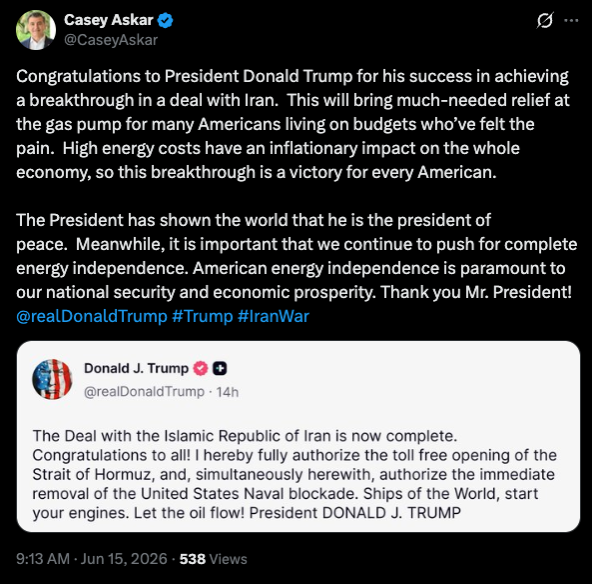
[Twitter, @CaseyAskar, 6/15/26]
Askar Said Trump Was Acting “Very Effectively, Very Strategically” With Iran And “I Support Not Having A Nuclear Iran, I Support Not Having A Terrorist State.” According to an interview with Casey Askar with Gulf Coast News, HOST: The Iran War is certainly one of those escalating… ASKAR: Nobody wants war. Our president doesn’t want war. But Iran is a real threat. HOST: You supported getting into the war? ASKAR: I support not having a nuclear Iran, I support not having a terrorist state. He’s doing it very effectively, very strategically.” [Gulf Coast News, 5/22/26] (video)
¶ Trump’s War With Iran Was Costly For Floridians

¶ Regular And Diesel Gas Prices Across Florida Soared As A Result Of The War
HEADLINE: “‘Everything Is Expensive’: South Florida Drivers React To Rising Gas Prices As Iran War Tensions Intensify” [WSVN, 7/13/26]
HEADLINE: "Six Months Into The Iran War, Gas Is Up 37% — And August Is About To Set A Record" [ABC Gulf Coast, 8/27/26]
Florida Recorded A $3.89 Billion Increase In Gasoline Spending Since The Beginning Of The Iran War. According to Patch, “Higher gas prices have cost the average American household an extra $477 since the war with Iran began Feb. 28, adding up to more than $56.4 billion in extra spending nationwide, according to an analysis by Democrats in Congress. […] In raw dollars, Texas recorded the largest increase in gasoline spending at about $5.74 billion, followed by California at $5.45 billion and Florida at $3.89 billion. The state-by-state estimates underscore how changes in fuel prices can ripple differently across the country, especially in places where people drive longer distances or consume more gasoline overall.” [Patch, 7/23/26]
- HEADLINE: “Americans’ Confidence In US Economy Falls As Iran Conflict Sends Gas Prices Higher” [ABC 27 News, 7/28/26]
July 2026: The National Average Price For A Gallon Of Gas Was Approaching $4 Again After Trump Declared A Ceasefire Was Over. According to Arizona’s Family, "Gas prices continue to inch up after President Donald Trump declared the ceasefire agreement with Iran was ‘over.’ AAA reported the average price for a gallon of regular gasoline was just shy of $4, at $3.98 a gallon. On Thursday, the average price of diesel was back up to about $5 a gallon. Oil and gas prices had been declining after the U.S. and Iran signed a peace plan to end the war in June." [Arizona’s Family, 7/17/26]
- The War With Iran Caused Fuel Inventories To Plunge To Historic Lows, Leading To A Major Surge In Gas Prices. According to the Washington Post, "Americans face a new round of punishing price increases for fuel and other products as oil and gas inventories plunge to historic lows around the world because of the war in Iran, energy executives and analysts warn. Fuel stocks are so low, experts said, that even an abrupt agreement between the United States and Iran and an immediate reopening of the Strait of Hormuz — through which one-fifth of the world’s oil and natural gas supplies passed before the war — may not stop fuel prices from soaring anew by the July Fourth holiday." [Washington Post, 6/3/26]
- HEADLINE: “Oil Prices Surge After Trump Vows Retaliation For Iranian Attack” [ABC News, 7/29/26]
8/6/26: Diesel Cost An Average Of $5.37 In Florida.
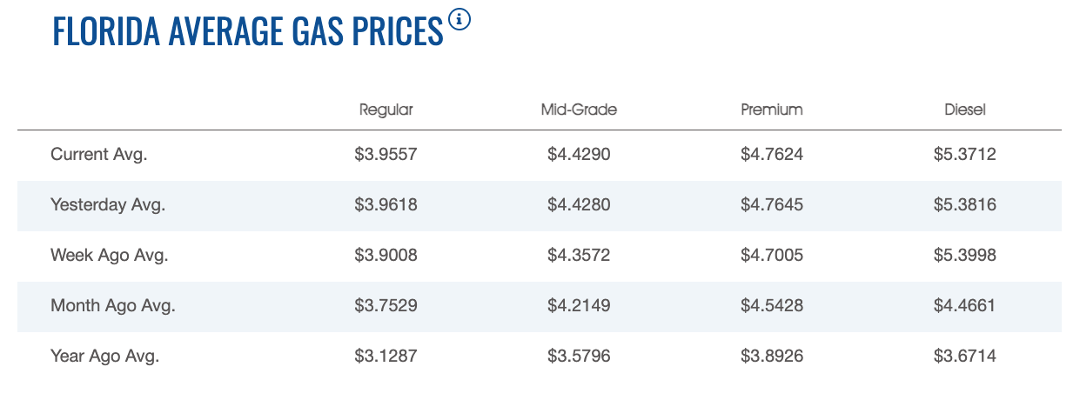
[AAA, Florida Fuel Prices, Viewed 8/6/26]
- HEADLINE: “'You Can't Make Revenue,' Florida Businesses Lament Rising Gas Prices” [Daytona Beach News-Journal, 4/4/26]
Trump’s War With Iran Was Costing Florida Families At The Grocery Store
HEADLINE: “Experts Say Florida Grocery Costs Will 'Hit Harder Than We Think'” [Daytona Beach News-Journal, 4/13/26]
July 2026: Prices For Fresh Food, School Supplies, And Any Goods That Required Shipment Were Expected To Increase Amid Energy Price Increases Due To The United States’ War With Iran. According to PBS, “Already feeling pinched since the start of the Iran war, consumers are likely to feel more pain ahead as oil prices pushed past $100 a barrel Thursday amid renewed fighting and military strikes that have left global oil supplies stranded in the Middle East. The elevated price marked a turn from lower oil prices enjoyed briefly when hostilities between the U.S. and Iran waned in June. Brent crude, the international standard, last reached $100 a barrel in May. Companies that produce and sell fresh food, school supplies and anything that gets shipped using fuel reported cost impacts from an earlier spike in energy prices after the U.S. and Israel attacked Iran. They're likely to continue passing some of their increased expenses to consumers.” [PBS News, 7/24/26]
May 2026: Economists Said The Full Impact Of Rising Energy Costs On Food Was Yet To Hit Retail Grocery Prices. According to the Orlando Sentinel, “The full impact of rising energy costs on food likely has not hit retail grocery prices yet in the U.S., according to Purdue University economists Ken Foster and Bernhard Dalheimer. Higher costs to produce, process, store and transport food can take three to six months to show up on supermarket shelves, where prices typically fall slowly once increased, they said. ‘Most of what we’re seeing now in the food price chain probably predates the conflict,’ Foster, a professor of agricultural economics, said. ‘We’re cautiously waiting to see what the June numbers and the May numbers might show as they come out in terms of … the extent to which energy shocks in the Strait of Hormuz and shipping blockades and so forth are going to impact food prices.’ The consumer price index measures changes in what people in U.S. cities paid at retail stores for meat, bread, milk, produce and other grocery staples. Over the last 20 years, grocery prices increased an average of 2.6%, according to the U.S. Department of Agriculture.” [Orlando Sentinel, 5/13/26]
Tomatoes, Bananas, And Onions Experienced Major Price Hikes Since The Beginning Of The War. According to Fortune, "The U.S., Israel, and Iran agreed to a two-week ceasefire on Tuesday, but the sticker shock you’ve been feeling every time you go to the grocery store will get worse if the war continues. One of the first places you’ll feel it will be the produce aisle, experts say. A Fortune analysis of produce wholesale prices from USDA data found grocery-cart staples such as tomatoes, bananas, and yellow onions have experienced significant price spikes since the war began. The United Nations reported its global food price index rose by 2.4% in March, the second consecutive month of rising prices." [Fortune, 4/8/26]
- HEADLINE: "Higher Prices For Gas, Groceries And Flights Will Likely Outlast The Iran War" [AP News, 6/16/26]
¶ The War With Iran Cost U.S. Families $100 Billion So Far
As Of June 2026, The War In Iran Cost U.S. Families $100 Billion So Far. According to Fortune, "$750 a household—or $100 billion. This is the cost that Moody’s has calculated the Iran War has been so far to the U.S. consumer. Mark Zandi, chief economist at Moody’s Analytics, said the cost passed on to households is the result of increased military spending and higher prices as a result of oil supply disruption out of the Middle East. Since the U.S. and Israel launched action against Iran—setting off a domino-effect of attacks across the Middle East—brent crude has topped $110 a barrel on multiple occasions." [Fortune, 6/2/26]
Americans, By A Margin Of 56 Percent To 7 Percent, Expected Trump’s War In Iran To Have A “Mostly Negative Impact” On Their Personal Financial Situation. According to The Washington Post, “Americans, by a margin of 56 percent to 7 percent, expect the war to have a ‘mostly negative impact’ on their personal financial situation, according to a March 31 Ipsos poll. A Middle East conflict that lasts for several more months would almost certainly spread higher prices and supply chain disruption beyond Asia and Europe to American shores. ‘I don’t think the U.S. will avoid it. These are global markets,’ said Rachel Ziemba, a New York-based analyst who advises corporations on geopolitical risk. ‘Experts, even a week ago, were worried. Now they are more worried.’” [Washington Post, 4/4/26]